
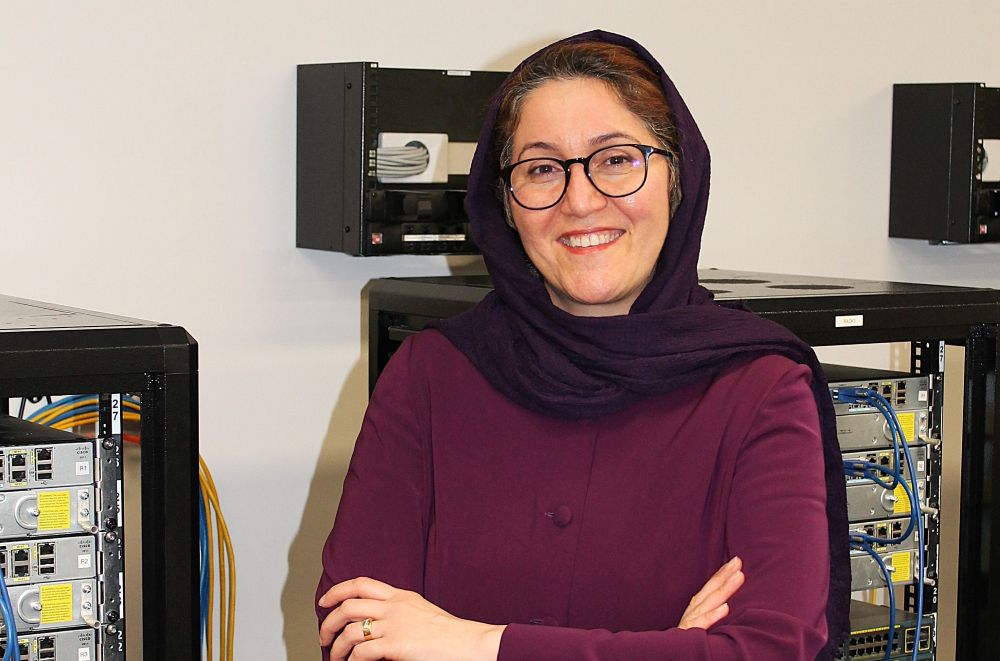
 Zahara Jadidi / Image supplied
Summary
For many young women, confidence can be the deciding factor between imagining a career in technology and pursuing one. A new Griffith University project will help girls and women build the skills to navigate AI-enabled cyber risks while exploring future pathways in STEM and cybersecurity.A teacher's encouragement in Year 10 changed the course of Dr Zahra Jadidi's life.
More than 20 years later, the Griffith University lecturer and First Year Coordinator for the School of Information and Communication Technology is drawing on that experience to help young people develop the skills and confidence needed to navigate an increasingly digital world.
Her project, Empowering Girls and Women Educators to Navigate AI-Enabled Cyber Risks, secured funds through the Queensland Government's Empowering Queensland Women Grants program and is expected to commence in 2027.
Empowering young women to understand AI and cyber risks
The program will combine practical cyber awareness training with exposure to cybersecurity and STEM career pathways, helping participants build online resilience while broadening their understanding of future employment opportunities.
For Dr Jadidi, however, the initiative is about more than technology. "When I was in high school, one of my teachers believed in me and encouraged me to pursue my goals. That support stayed with me," she says.
"I wanted this program to focus on high school and university students because it is the best time for young women to build confidence and make plans for their future without thinking, 'I can't do that'."
Boosting young women's capability and confidence to operate in AI spaces will help them to mitigate cyber security threats while harnessing the economic and career opportunities that new technologies will create.
Why AI literacy and cyber security awareness matter
The project was sparked by conversations with teachers and students that highlighted a growing gap in awareness around AI-enabled cyber threats.
"For most of my career, the focus has been on how AI can help cybersecurity and benefit people, but with the rapid growth of AI, there are also a growing number of challenges that come with it," says Dr Jadidi.
"When I spoke with teachers and students, it became increasingly clear that while people understood the benefits of AI, many were not aware of the threats associated with it.
"When I saw the grant opportunity, I thought it was the perfect chance to address that gap."
Through interactive workshops, participants will learn how AI can be used to create convincing phishing emails, deepfakes, fake videos and voice scams.
"Many AI-generated emails, images and voices now look incredibly real. People need to understand how similar fake content can be to genuine content and how dangerous it can be," says Dr Jadidi.
"If people don't know the risks, they can make mistakes. We want to teach them preventative measures to limit the risk of them becoming victims of cyber threats in their personal and professional lives."
Dr Jadidi says improving digital literacy was not only about staying safe online but also protecting economic security.
"The main aim of many cyber-attacks is to impact people financially. Creating awareness helps people avoid making mistakes that could have significant financial consequences."
Building confidence in cyber security and STEM careers
The program will also connect participants with women working in technology and cybersecurity, helping them better understand study and career opportunities in the sector.
"I definitely plan to bring women working in technology and cybersecurity to speak with students," says Dr Jadidi.
"It's important for young women to understand the possibilities before they make decisions about university and their careers."
The power of representation for young women in technology
Throughout her teaching career, Dr Jadidi has seen how powerful representation can be.
"Many of my female students told me they weren't used to seeing women teaching technical subjects. When they see someone who looks like them working in technology, it helps them believe they can do it too."
Dr Jadidi says creating confidence is one of the initiative's most important outcomes: "I don't like seeing girls choose not to do something because they lack confidence.
"What we try to do is show them they are capable of working in STEM, cybersecurity and technical careers."
Creating new pathways for Queensland women and girls
More than two decades after a teacher helped her recognise her own potential, Dr Jadidi hopes the program will help participants see new possibilities for themselves.
"That was the reason that I was very excited about this grant application," she says.
"I felt like I was repeating my life and my history."
Queensland Government investment in women's economic security
The Griffith University project is one of 30 initiatives funded through Round 2 of the Queensland Government's Empowering Queensland Women Grants program.
With almost $280,000 invested across Queensland, the program supports community-led projects that help women build skills, leadership capabilities, financial confidence and pathways to employment, strengthening economic security for women and girls across the state.
Learn more and view the full list of recipients
Improving financial knowledge and economic participation are two strategic pillars of the Queensland Government Women's Economic Security Strategy.
 This work is licensed under a Creative Commons Attribution 4.0 International (CC BY 4.0) licence